PufferPhish
A Chrome extension that detects phishing in real time using a hybrid approach: a pre-trained CodeBERT classifier for URL-level inference and a rule-based engine that catches structural patterns like homoglyphs, brand spoofing, and suspicious subdomains.
Senior capstone project · University of Michigan · 2025
Warning Interstitial
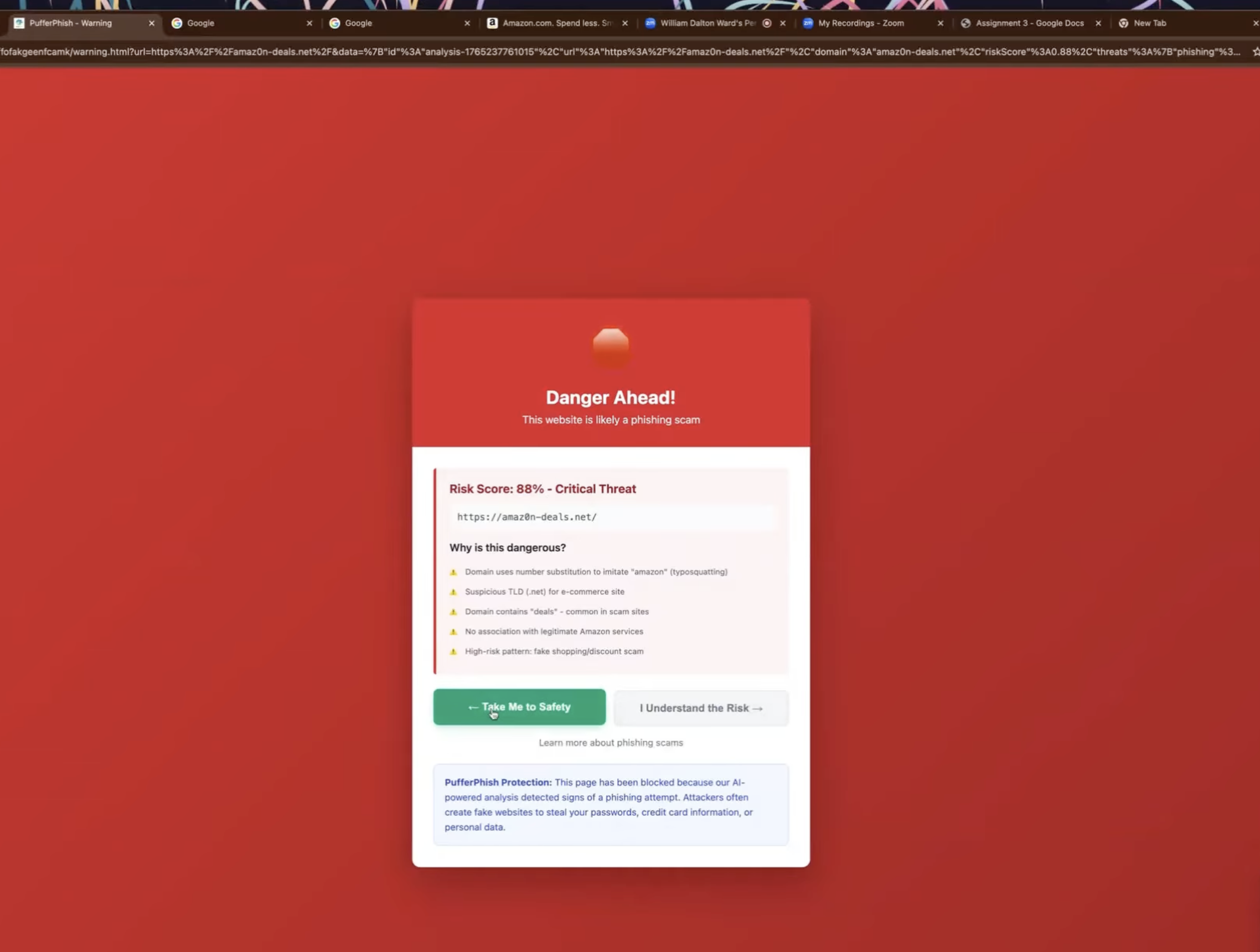
When a URL scores above the danger threshold, the extension redirects the browser to a full-page warning before the page loads. The interstitial explains exactly why the site was flagged: number substitutions imitating known brands, suspicious TLDs, lack of association with legitimate services, and high-risk URL patterns. Users can return to safety or acknowledge the risk and proceed.
Dashboard
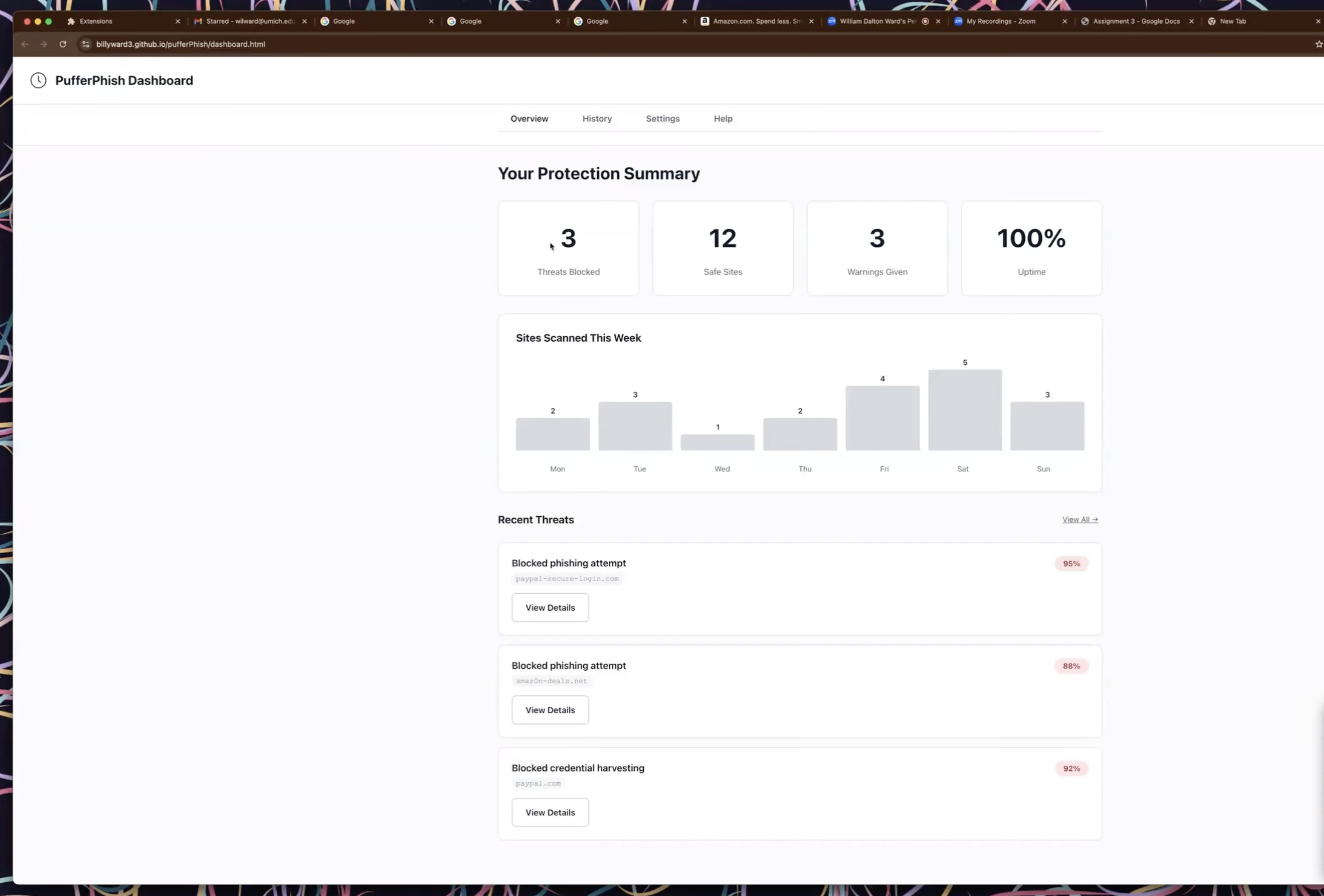
The web dashboard aggregates scan activity across all browsing sessions. The overview tracks threats blocked, safe sites visited, and warnings issued alongside a weekly scan volume chart. The history tab provides a searchable, filterable log of every blocked attempt with threat types, risk scores, and the option to view full reports or whitelist false positives.
.png)
How It Works
Every URL you visit passes through two detection layers that run in parallel. The final risk score takes the higher of the two, and rule-based flags are always appended for explainability so users see exactly why a URL was flagged.
ML Classification
A CodeBERT model (via ProtectAI's ONNX-optimized checkpoint) classifies URLs into four categories: benign, phishing, malware, and defacement. The model runs as a separate Python service and returns confidence scores for each label.
Rule-Based Analysis
Scores URLs across three weighted dimensions: URL structure patterns like IP-address URLs, excessive subdomains, and URL encoding tricks (40%); domain reputation signals like homoglyph substitutions, phishing keywords, and digit injection (40%); and content indicators like suspicious path patterns, brand spoofing, and non-standard ports (20%).
Risk Thresholds
| Risk | Action |
|---|---|
| Below 30% | Safe. Green shield icon with scan stats in popup. |
| 30% to 70% | Warning. Amber alert with threat details in popup. |
| Above 70% | Danger. Auto-redirect to full-page warning interstitial. |
Architecture
The system is a Turbo monorepo with five packages. The Chrome extension's service worker intercepts every tab navigation and sends the URL to a Node.js API running on AWS Lambda. The API checks a 24-hour PostgreSQL cache, then fans out to the ML engine and rule-based analyzer in parallel. Infrastructure is defined as code with AWS CDK: Lambda functions, API Gateway, RDS, S3 for model storage, Cognito for auth, and CloudFront for the dashboard.
Chrome Extension (Manifest v3)
  ├── Service Worker    analyzes URLs on tab navigation, caches results
  ├── Popup UI          risk score, threat flags, scan statistics
  ├── Warning Page      full-page interstitial for blocked sites
  └── Content Script    page-level interaction
        │
        ▼
API (Node.js, AWS Lambda)
  ├── /analyze     validates URL, checks cache, invokes ML + rules
  ├── /stats       scan counts, threats blocked, recent analyses
  ├── /settings    auto-block, notifications, domain whitelist
  └── /feedback    logged user corrections
        │
        ▼
ML Engine (Python, AWS Lambda)
  └── CodeBERT ONNX    4-class URL classification
        │
        ▼
PostgreSQL (AWS RDS)
  └── Analyses, URL cache (24h TTL), settings, threat intel
Built with
Context
Senior capstone project at the University of Michigan, 2025. Led the team and wrote the full codebase. The detection system combines a pre-trained CodeBERT model from Hugging Face with a hand-tuned rule-based engine, deployed on AWS with CDK-managed infrastructure. PufferPhish is a working prototype; it was not published to the Chrome Web Store and detection accuracy was not formally benchmarked.